
Face Search Accuracy Explained For Real-World Photos
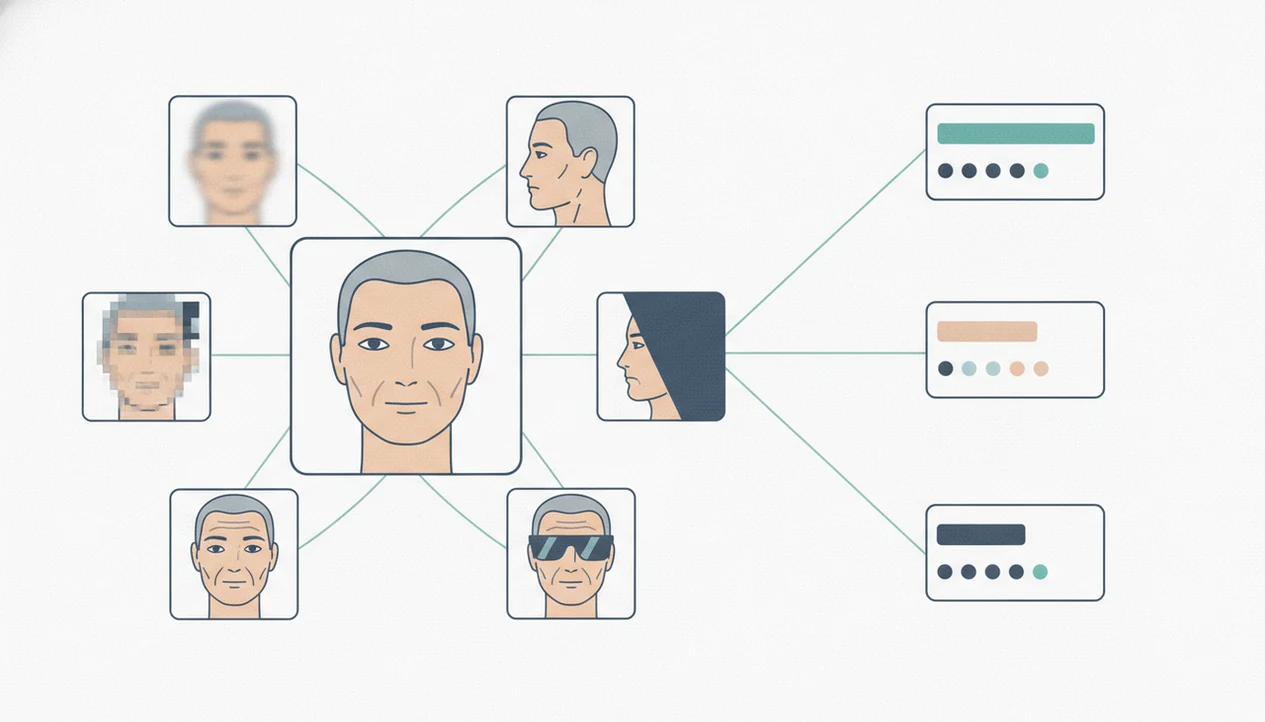
Face search accuracy is strongest when the uploaded photo is clear, frontal, well lit, recent, and matched against an index that actually contains the person’s public images. Treat results as ranked visual leads, not proof of identity, because scores can be affected by photo quality, pose, age, lighting, look-alikes, source coverage, and algorithm thresholds.
> Definition: Face search accuracy means how reliably a face search system returns the same person, or a truly similar face, from a submitted photo under real-world conditions.
- A high similarity score means the faces look close to the algorithm, not that identity is legally confirmed.
- NIST testing has shown top facial recognition systems exceeding 95% accuracy on controlled, high-quality images, but those results do not fully predict selfies, screenshots, filters, or compressed social images source.
- The biggest real-world accuracy factors are photo quality, pose, lighting, age gap, occlusions, index coverage, source quality, and demographic performance gaps.
Face Search Accuracy In One Definition
Face search accuracy means how reliably a face search system returns the same person, or a truly similar face, from a submitted photo under real-world conditions. Online face search usually ranks visual similarity; it does not prove legal identity.
Open-web reverse face lookup searches publicly available image sources and returns possible matches. Controlled facial recognition, such as access control or database verification, compares a face against a known gallery under tighter conditions. Those are different jobs.
Face Search App is a face search app that explains how to find people by photo, compare reverse face search tools, and check scam photos for everyday users. Accuracy depends on the model, but also on whether matching images exist in the searchable index. No indexed image, no returned match.
The source trail matters.
Face Search Accuracy Mechanics Behind Similarity Scores
Face search systems usually work by detecting a face, aligning it, converting it into a numeric face embedding, and comparing that template with other templates. In plain English, the system turns face structure into a searchable pattern.
First, the tool finds the face area. Then it normalizes landmarks such as eyes, nose, and mouth position. The model creates an embedding, which is a compact mathematical description of the face. Search results come from comparing distances between embeddings.
There are three different tasks. One-to-one verification asks, “Do these two photos show the same person?” One-to-many identification asks, “Which person in this known gallery is closest?” Open-set web search asks, “Are there visually similar faces in a large, incomplete public index?”
Thresholds decide how strict the system is. A stricter threshold reduces false matches but misses more true matches. A looser threshold catches more leads but adds look-alike noise. A confusing confidence score under a face match should be read inside that tool only, not compared across apps.
Before You Start A Face Search
Before you start a face search, choose the best lawful upload and decide what you will do with the result. The goal is to create a cautious source trail, not to turn one photo into an identity verdict.
- Choose the clearest recent image you can use, ideally a frontal, well-lit face where the eyes, nose, mouth, jawline, and forehead are visible.
- Avoid damaged uploads such as heavy filters, tiny crops, masks, sunglasses, screenshots of screenshots, or images crushed by social-media compression.
- Confirm your purpose is lawful, necessary, and proportionate before searching; curiosity alone is not a good reason to investigate someone.
- Get consent when the image is private or sensitive and do not search, save, or share intimate, restricted, or vulnerable-person images without permission.
- Prepare to verify every source page before trusting a match, including names, dates, captions, account history, and whether the image appears in a believable original context.
A clean upload can improve accuracy, but restraint improves safety. If the result could harm someone, slow down before acting.
Five Face Search Reliability Facts Users Should Know
- Face search tools optimize for visual similarity, not legal identity, so a match means “visually close” before it means “confirmed person.”
- Controlled lab results are usually stronger than results from screenshots, filtered selfies, cropped profile images, and compressed social posts.
- Quality, lighting, angle, occlusion, age gap, and facial expression can all change the match list.
- Index coverage and source quality can matter as much as algorithm quality, because tools cannot return images they never indexed.
- Demographic performance gaps and look-alikes mean every result needs source review before anyone treats it as meaningful.
For everyday checks, the safer question is not “Did the app identify them?” It is “Does this result create a source trail worth verifying?” Good face search app guides for finding people by photo, reverse face search, social profile lookup, and scam-photo checks deliver cautious leads and context, not certainty or permission to confront someone.
Face Search Accuracy Compared With Lab Facial Recognition
How accurate is face search? In controlled tests, facial recognition can be highly accurate; in open-web searches using messy public photos, reliability varies much more because photo quality and index coverage become limiting factors.
A 2018 NIST evaluation reported that the most accurate algorithm had a false non-match rate below 0.2% on high-quality visa photos, and most top systems exceeded 95% accuracy in that setting source. Those results matter, but visa photos are not the same as a tilted dating profile screenshot.
Lab sets often use frontal, standardized images. Public-photo search deals with filtered selfies, low-resolution reposts, side angles, and old uploads. We often see the familiar mismatch between a glossy profile portrait and a low-resolution repost on an old public page.
One-to-one verification asks whether two controlled photos match. Open-web face search asks whether the correct person appears in a searchable index at all. For open-web searches, missing coverage can beat a strong algorithm.
Photo Quality Factors That Change Facial Recognition Accuracy Online
Real-world facial recognition accuracy online drops when the face is small, blurred, compressed, filtered, poorly cropped, or far from the camera. A recent, clear face crop usually beats a full-body image or an old profile picture.
Resolution matters because the model needs enough facial detail. Screenshots can add compression. Filters can smooth skin, enlarge eyes, change jawlines, or alter lighting. Cropping can help when it removes clutter, but a crop that cuts off the chin or forehead may hurt matching.
Lighting is just as practical. Shadows hide eye sockets. Overexposure erases cheek and nose detail. Backlighting turns a face into a soft outline. Colored club light can shift skin tone and confuse the model.
Pose matters too. Side profiles, tilted heads, open-mouth expressions, glasses, hats, masks, heavy makeup, and hair across the face all change results. We have held a phone sideways to crop shoulders out of a group photo before searching. Small edits like that can improve the signal.
For most users, a clean face crop is often better than a wider social image because it removes background noise and preserves the features the model compares.
Index Coverage And Source Quality In Face Search Reliability
Face search can only return images available in the tool’s indexed sources. If the person’s matching images sit behind locked profiles, deleted pages, private accounts, uncrawled sites, or regional gaps, the tool may return nothing useful.
That does not prove absence.
Index coverage is the quiet part of face search reliability. A strong algorithm can still fail if the right public image is missing. The opposite can happen too: a weaker-looking match may appear because an old repost is the only indexed clue.
Source context changes how much weight a result deserves. Official pages, long-standing profiles, and repeated appearances across unrelated public sources are stronger than scraped thumbnails or anonymous reposts. Before acting, open three tabs: the original profile, the search result, and the platform help page. If privacy questions come up, the face search privacy guidance should shape the next step.
Face Search Accuracy Scores: A 5-Step Safety Workflow
Use face search accuracy scores as graded leads, not identity verdicts. Low scores are weak leads, medium scores are possible leads, and high scores are strong visual leads that still need context.
If the result could affect someone's safety, reputation, job, housing, or legal situation, do not rely on face search alone. Use it only to decide whether a source is worth reviewing.
- Upload the clearest image you have, preferably a recent, frontal, well-lit face crop without filters or heavy obstruction.
- Compare multiple results instead of trusting the first match; look for repeated appearances, not one lucky resemblance.
- Inspect source pages for names, dates, captions, account age, and whether the image appears in a believable original context.
- Check date order to see whether the image predates the profile you are reviewing or was copied later.
- Look for independent confirmation through platform behavior, public context, and consistent details before drawing conclusions.
Save a screenshot with the date visible before a result page changes. Then slow down. Do not harass, expose, stalk, contact, or accuse someone based only on a face search result. Tools like Face Search App, Google Lens, TinEye, and other lookup tools are starting points for documentation, not permission slips for confrontation.
Common Face Search Mistakes To Avoid
The most common face search mistake is treating a ranked visual lead as a confirmed identity. Avoid shortcuts that weaken the upload, ignore context, or turn one similar face into an accusation.
- Start with a proper face crop instead of a tiny cutout from a group photo. Keep the full face visible, with enough resolution for eyes, nose, mouth, forehead, and jawline.
- Read a high score cautiously because it only reflects that tool’s model and threshold. A strong score can still be a look-alike, an old image, or a repost.
- Check the source trail before trusting a result. Look at publication dates, captions, profile age, account history, and whether the same image appears on older or more credible pages.
- Avoid comparing scores across tools as if they use the same scale. A 90% result in one app is not the same measurement as 90% somewhere else.
- Confirm with independent context before acting. Match names, behavior, dates, platform details, and public records where appropriate, then decide whether the lead is strong enough to matter.
If a result feels urgent, pause. Urgency is exactly when mistaken identity does the most damage.
Common Myths About Face Search Accuracy Online
Several myths make face search results look more certain than they are. The first is that a 99% similarity score guarantees the same person. It does not; it means the faces are very close under that model’s scoring rules.
A second myth is that lab accuracy applies equally to random social photos. Lab systems may use clean, frontal, high-resolution images. Social images bring filters, motion blur, screenshots, compression, and odd angles.
A third myth is that face search scans the entire internet. It scans whatever a tool has indexed or can reach. Locked accounts and deleted pages may be invisible.
Another myth is that modern systems perform equally across every demographic group. NIST has documented uneven error rates across demographic categories in some algorithms.
One result is not enough for a scam-photo check. A group chat dissecting one polished headshot may catch a risk signal, but the safer move is to corroborate before acting. If the question is lawful use, is face search legal belongs in the workflow.
Confidence Scores, Thresholds, And False Face Matches
A false positive is a wrong person returned as a likely match. A false negative is the same person missed by the system. Both can happen, especially with poor images or incomplete source coverage.
Thresholds control that tradeoff. Stricter thresholds reduce false positives but increase missed matches. Looser thresholds find more possible leads but produce more look-alike noise. That is why a score cannot be read like a school grade.
NIST's Face Recognition Vendor Test program shows that error rates can be very low in constrained evaluations, but performance can degrade with lower-quality images and cross-demographic comparisons. NIST's demographic-effects report also found that false positive rates for some Asian and African American groups were 10 to 100 times higher than for white faces in tested algorithms, depending on the algorithm source source.
Evaluate the upload, source context, dates, and repeated evidence. A red pen circling a weak resemblance on a printout is a reminder: one score is not enough. The broader AI face search limitations are part of accuracy, not a footnote.
Limitations
Face search is useful for finding possible public-photo leads, but it has hard limits. Treat the list below as safety guidance before using any result.
- Lab accuracy statistics do not fully reflect messy real-world photos, screenshots, filters, and compressed uploads.
- Tools cannot match people whose images are not indexed, public, reachable, or still online.
- Low-quality uploads can cause missed matches, wrong look-alike results, or unstable similarity scores.
- Government testing has documented demographic accuracy gaps, including higher false positive rates for some groups.
- Age changes, cosmetic changes, facial hair, weight changes, and old photos can reduce reliability.
- Similarity scores are not legal identity verification, even when they look precise.
- Face search should not be used for harassment, doxxing, stalking, employment screening, housing decisions, or other high-stakes decisions.
- Consent still matters when searching, saving, or sharing someone’s image; the consent and ethical photo lookup workflow is often the safer frame.
Apps such as Face Search App can help structure a cautious review, but the final judgment should come from corroborated public context, not one ranked result.
FAQ
How accurate is face search with real-world photos?
Face search accuracy varies by photo quality, algorithm, index coverage, and whether the task is one-to-one verification or open-web search. Treat results as leads, not proof.
Is a 99% similarity score proof of identity?
No. A 99% similarity score is a strong visual signal inside that tool, but it is not legal or factual proof of identity.
Why do face searches fail to find a match?
Common causes include poor image quality, side angles, occlusions, old photos, missing index coverage, and private or deleted source pages. A failed search does not prove the person has no online presence.
Do selfies reduce face search accuracy?
Selfies can reduce reliability when they use filters, extreme angles, compression, unusual expressions, or difficult lighting. A clear frontal selfie may still work well.
Are face search scores comparable across different tools?
No. Scores differ by model, database, threshold, and scoring scale, so a 90% score in one tool does not equal 90% in another.
Can face search find anyone online?
No. Face search only works when matching or visually similar public images exist in the searchable index used by the tool.
What photo works best for face search?
A clear, recent, frontal, well-lit face image with minimal obstruction and enough resolution usually works best. Avoid heavy filters, masks, sunglasses, and tiny full-body crops.
Can look-alikes fool face search tools?
Yes. Similar facial structure, twins, relatives, old photos, and AI-edited images can create misleading matches.
Is facial recognition biased across demographic groups?
Government testing has documented demographic performance gaps in some facial recognition systems. Users should treat face search results cautiously and verify with independent evidence.
Can face search verify a suspected scammer?
Face search can support a scam-photo check by showing where an image appears online. Combine it with profile behavior, source dates, platform reporting tools, and independent evidence before acting.